Funky Flower: Adding a Joyful Touch to Your Creative Projects
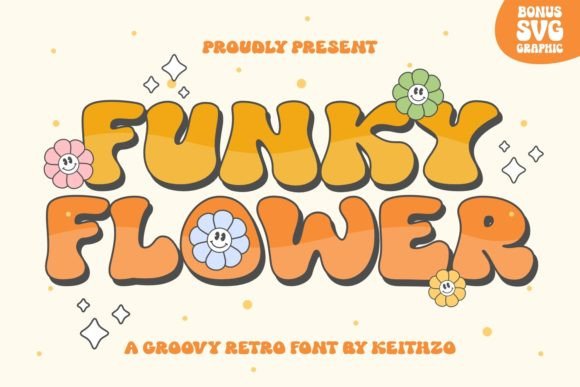
When you first encounter the Funky Flower display font, you immediately get a sense of its personality. It’s a typeface that doesn’t just sit quietly on the page; it makes an entrance. This is a cute and quirky display font designed to inject an incredibly joyful and playful energy into any design it touches. In a world saturated with serious, minimalist sans serif fonts and traditional serifs, Funky Flower offers a refreshing burst of character. It’s the kind of creative font that can transform a standard layout into something memorable and full of life, making it a valuable addition to any designer’s toolkit.
Funky Flower is a premium font that thrives in projects where personality and warmth are key. Its visual characteristics are defined by its rounded, friendly letterforms and a distinctive, whimsical flair that feels both modern and approachable. This isn’t a font for lengthy body copy in a legal document; it’s a display typeface meant to shine in headlines, logos, and branding elements where first impressions are everything. The overall appeal lies in its ability to communicate fun, creativity, and approachability without saying a word. For entrepreneurs, bloggers, and small business owners, it’s a powerful tool for building a brand identity that feels human and engaging.
Where Funky Flower Truly Blossoms
Understanding where a font works best is crucial for effective design. Funky Flower excels in applications where you want to capture attention and evoke positive emotions. Its style makes it a natural fit for logo design, especially for brands in children’s products, creative studios, bakeries, florists, or any service that wants to project a friendly and innovative image. The font’s unique character helps create logos that are instantly recognizable and full of charm.
Beyond logos, consider Funky Flower for packaging design. Imagine it on a label for artisanal jams, craft supplies, or specialty coffee—the font itself becomes part of the product’s story, suggesting care, quality, and a touch of whimsy. In editorial design, it can be used for magazine headers, chapter titles in books, or feature article titles to draw readers in. For digital spaces, this creative font is perfect for social media graphics, website hero sections, and email newsletter headers. It makes content stand out in a crowded feed, increasing the likelihood of engagement. Crafters and hobbyists will also find it invaluable for personal projects like custom invitations, greeting cards, scrapbooking, and DIY home decor. Its joyful touch makes every project feel more special.
The Impact on Your Brand and Audience
Choosing a typeface like Funky Flower is a strategic decision that influences how your audience perceives you. Fonts are a silent ambassador for your brand. A well-chosen display font can significantly shape brand perception. Using Funky Flower consistently across your materials—your website, business cards, and social media—helps build a cohesive and recognizable brand identity. It tells your audience that you value creativity and have a friendly, approachable personality. This consistency is key to professionalism; it shows thoughtful curation rather than random choices.
Visual hierarchy is another critical area where Funky Flower proves its worth. Its bold and distinctive nature makes it perfect for headings and subheadings, guiding the reader’s eye through your content in a logical and appealing way. While it’s important to pair it with a more neutral body font (a classic sans serif or serif font often works well) to maintain readability for longer text, Funky Flower ensures your key messages and titles grab attention. This thoughtful pairing enhances the overall design, making your layouts more dynamic and easier to navigate. The result is improved audience engagement, as the design itself becomes more inviting and enjoyable to interact with.
Practical Guidance for Using This Typeface
Before integrating any new font into your workflow, it’s wise to evaluate its fit for your specific project. Start by reviewing the font’s full character set and any included styles. Funky Flower, as a premium font, likely comes with a comprehensive set of glyphs, including alternates, ligatures, and multilingual support, which can add even more versatility to your designs. Test these features in your design software to see how they can enhance your typography.
Next, consider font pairing. A strong pairing creates balance and contrast. Since Funky Flower is a playful display font, it pairs beautifully with clean, simple sans serif fonts for body text. This contrast allows the headline font to shine while ensuring the main content remains highly readable. Avoid pairing it with another highly decorative script font or handwritten font, as this can create visual clutter and reduce legibility. Always test your pairings in context—mock up a social media post, a product label, or a webpage header to see how the fonts work together in a real-world scenario.
Readability is paramount. Use Funky Flower at larger sizes where its details can be appreciated. For very small text, such as captions or fine print, it’s best to switch to a more straightforward typeface. Finally, pay close attention to commercial licensing. If you’re using the font for client work, merchandise, or a business website, you need to ensure you have the correct license. Most premium fonts, including Funky Flower, offer clear licensing options for personal and commercial use. Investing in the proper license protects you legally and supports the type designers who create these valuable assets.
Incorporating Funky Flower into your design library opens up new possibilities for creativity. It’s more than just a set of letters; it’s a design asset that carries emotion and personality. By applying it thoughtfully—considering context, audience, and pairing—you can leverage its joyful character to make your projects stand out, connect with your audience on a deeper level, and build a brand identity that is both professional and uniquely you.